A company preparing for an overseas exhibition builds a booth, presents its products, and gets brochures and business cards ready.
Buyers do not evaluate you only on the show floor
Before the show they look for suppliers with the technology they need. After meeting you they go back and check your expertise, product specifications and deployment cases again. When a new project begins they search from the problem they want to solve, without knowing your company name.
If the buyer asks an AI somewhere along the way, can your public information answer that question?
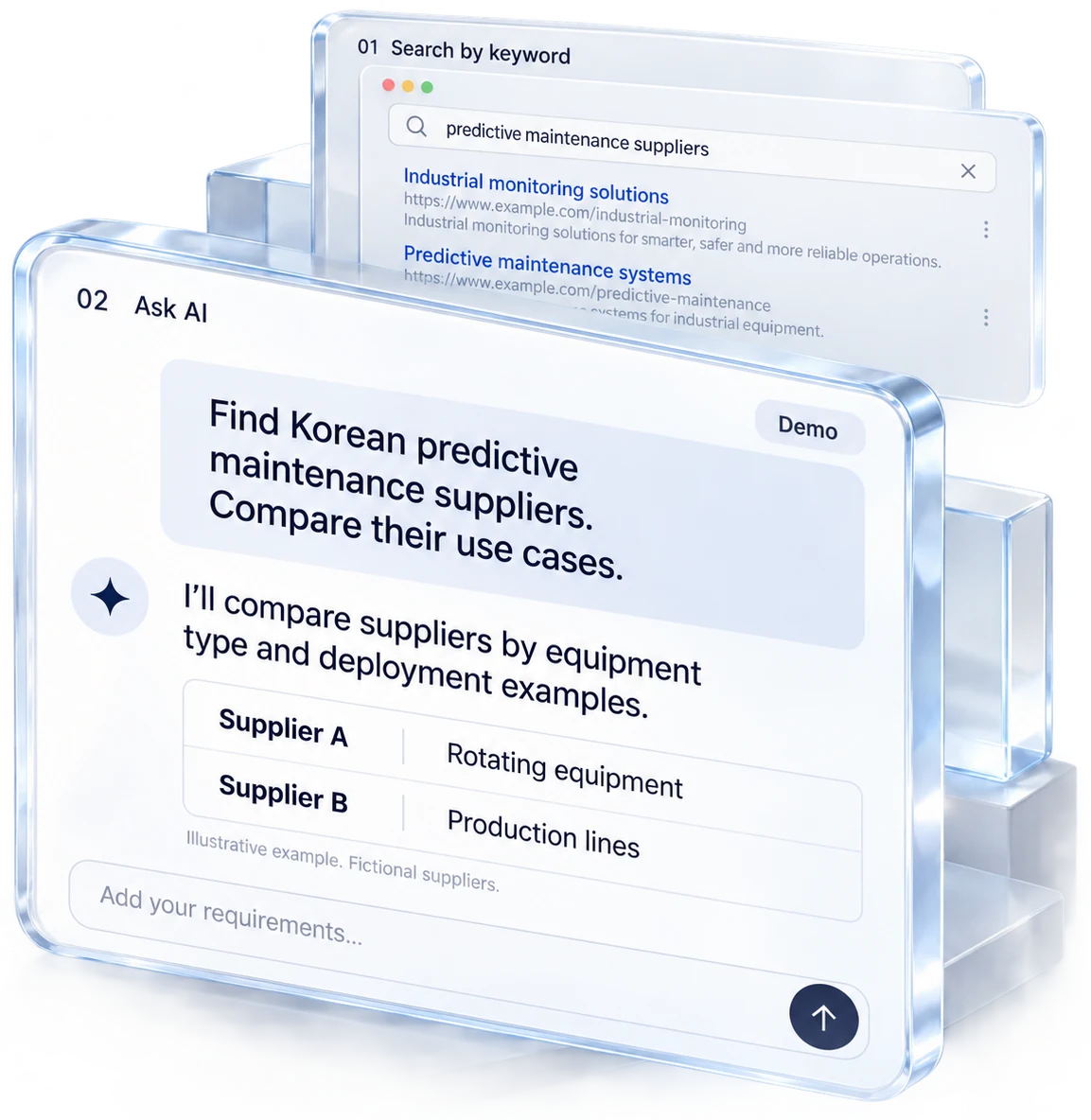
AI visibility is about how your company is understood
The degree to which a company and its products are found, explained and used as a source in AI-based search and answers.
Source · co-authored book Trading on a Hyperconnected Planet
CONNECT AI applies this to how overseas buyers search and evaluate. When a buyer asks for a technology or a supplier, the public information has to let them understand what you supply and which conditions you fit.
A buyer may ask questions like these.
- Find me Korean suppliers whose solution detects equipment failure before it happens.
- Is there a company that delivers sound to one specific zone only?
- We want to cut energy use — which products and suppliers should we compare?
None of these questions contains a company name. They contain a use case, a problem to solve and an operating environment.
So a product name and a company introduction may not explain enough. What problem you solve, where it can be applied, and what material backs that explanation all have to be visible.
Having a website is not the same as having something to evaluate
Companies that already have a website and brochures can still run into the following.
- The benefits are stated, but the concrete specifications and operating conditions are hard to find.
- Deployment cases exist, but they are not connected to the product that was used.
- A certification is mentioned, but what it covers and which document supports it are hard to check.
- The company introduction and the product material use different names or different descriptions.
- A buyer finds an interesting product, but how to request material or ask for a quote is unclear.
Each piece of material may exist, and the information a buyer needs in order to understand and compare one product may still be scattered.
To answer “can we apply this product in our plant?”, a product introduction is not enough — the equipment it applies to, the operating conditions and the related cases are needed too. When those are not connected, the buyer has to request more material or go looking for it.
When an AI answers by referring to public material, gaps in accessible information and evidence can limit what it can explain. That said, a company can be absent from a particular answer for many reasons, so missing material alone does not determine whether it is recommended.
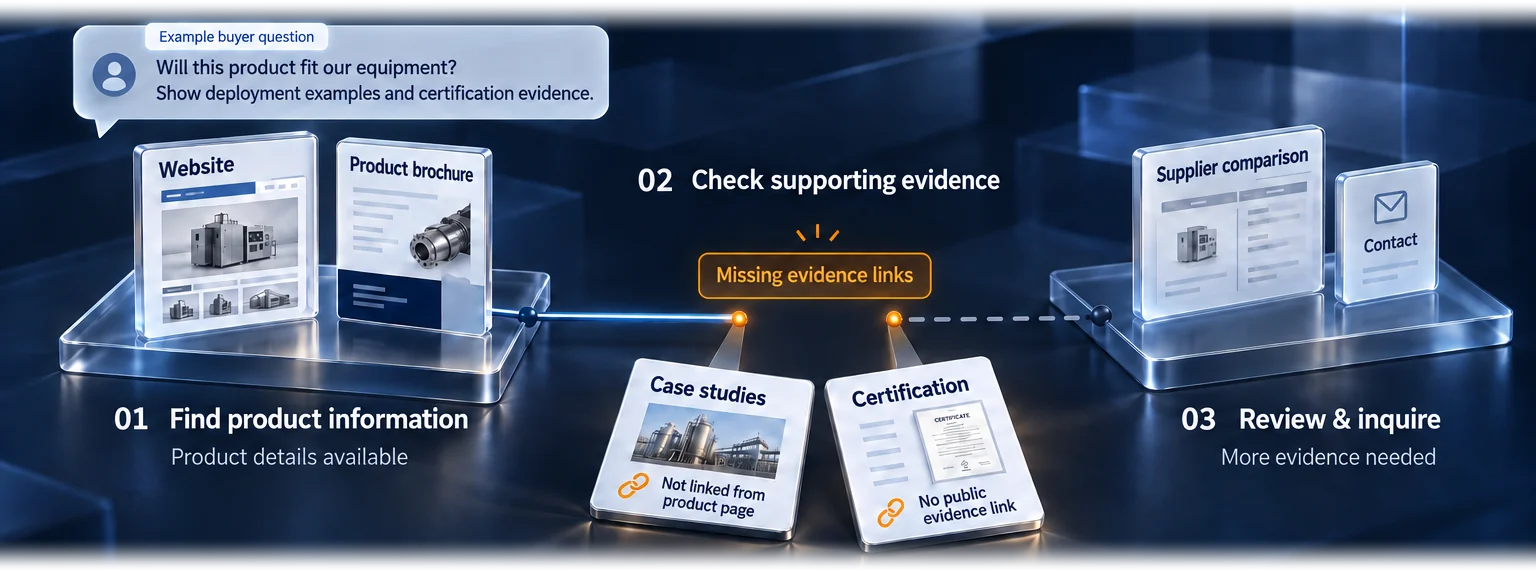
The product still has to explain itself after the show
On the show floor your staff can answer a buyer’s question on the spot. Once the buyer leaves, the public material has to carry that explanation.
The buyer may introduce the product internally, compare it with other suppliers, or assess whether to adopt it. If the product page and the technical material hold the explanations they need, the conversation from the floor is easier to continue.
The same material serves buyers you have never met, because they may reach your product while looking for a specific technology or deployment case.
There are two questions a company should be ready for.
Can someone finding us for the first time understand what the product is for?
Can a buyer we have already met find the evidence their evaluation needs when they come back?
Preparing information for AI visibility means holding both situations in view at once.
Connect a product-led explanation to the buyer’s question
What you actually need depends on the product and the target market. The following shows the direction, not a fixed list.
| What the company presents | What the buyer wants to confirm |
|---|---|
| Company technology | Where is the expertise, and what can be supplied? |
| Key product functions | Which problem does it solve, and under what conditions can it be used? |
| Product specifications | Does it fit our existing equipment or operating environment? |
| Delivery and deployment cases | Has it been used in a comparable environment? |
| Certifications and test reports | Which product do they cover, and what do they support? |
| Contact | Where do technical questions, material requests and quotes go? |
Organised this way, the website, the e-brochure and the FAQ explain the same product consistently. Connecting the evidence that can be published, and pointing to where questions go, also helps the buyer decide what to do next.
JD Solution: material that answers the buyer’s question
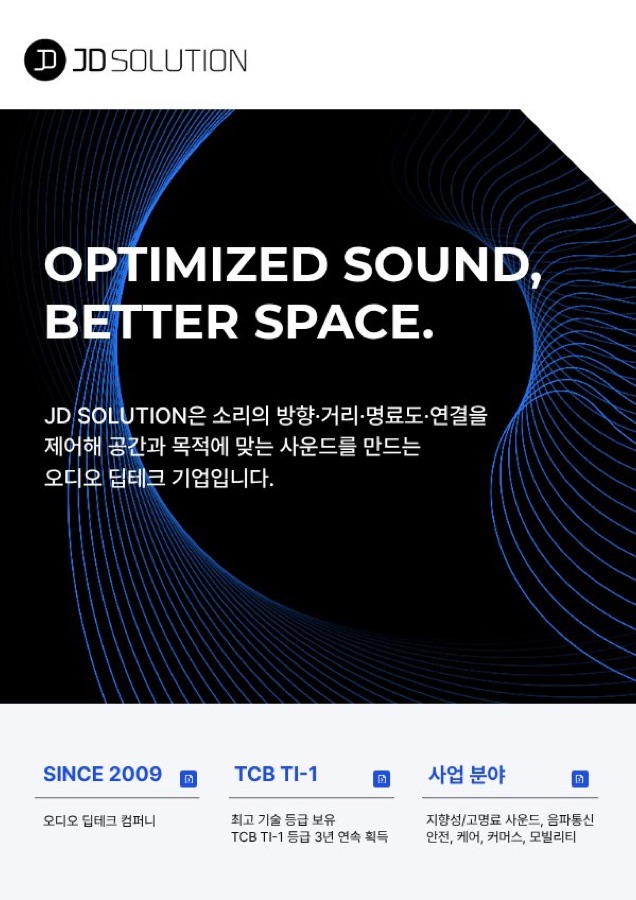
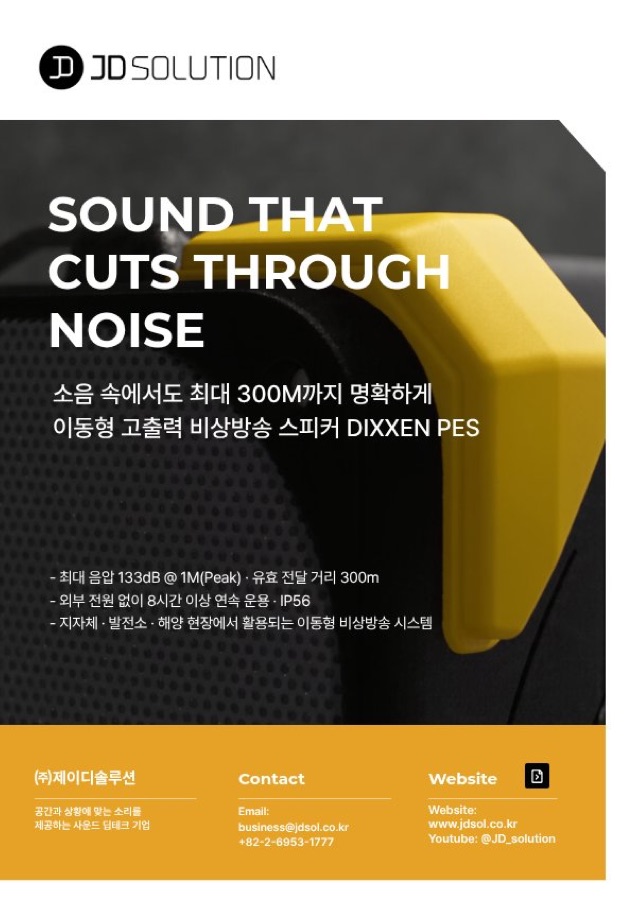
The JD Solution material CONNECT AI produced is an example of arranging company and product information around the buyer’s questions.
The company introduction explains the audio expertise and the business areas. The DIXXEN PES material introduces the use case and key characteristics of a portable emergency broadcast speaker. The BRICK / BRICK mini material shows where directional sound applies.
Each piece answers a different question.
What kind of technology does this company have?
Which problem does it solve?
Where can it be applied?
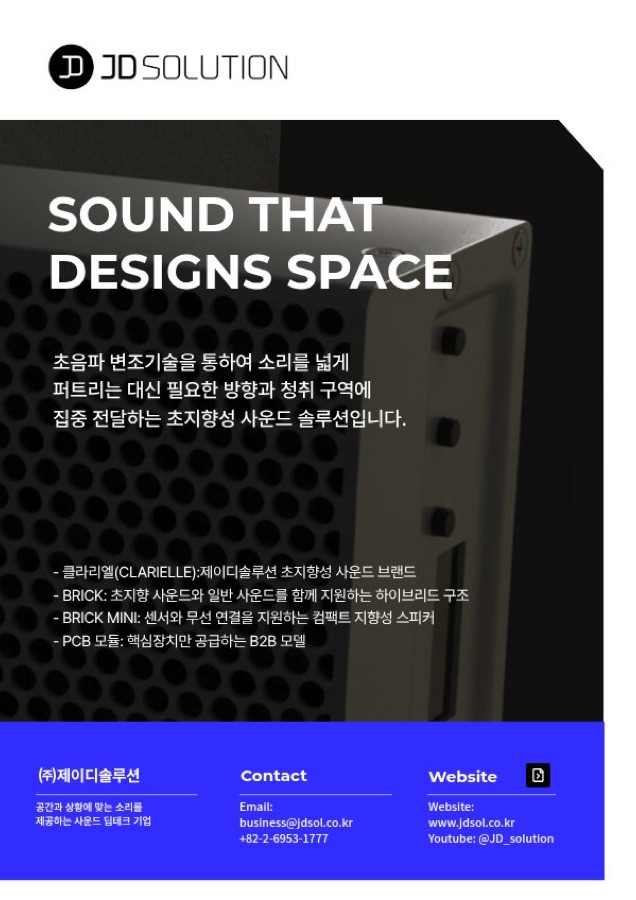
What matters in this example is not how many brochures there are. It is what answer each piece gives to the buyer’s evaluation question.
Every company starts from different material and different gaps, so what has to be produced differs too. For some the first step is improving the existing website; for others it is organising the product explanation or the deployment cases.
What do the twelve weeks prepare?
AI Visibility Export 12 from CONNECT AI is a programme that improves your existing material against the check results and builds the content and functions you need.
It organises the company and product explanations, connects the cases and evidence that can be published, and puts a path for material requests and inquiries in place. Where needed it also covers an FAQ and product guidance, follow-up on inquiries through MORI, and a handover so your own staff can run it.
These are examples of what can be built, connecting the company introduction, the product information, the evidence, and the inquiry and its follow-up. The items and quantities are agreed from the check results and the material you already have.
The same bundle of website and brochures is not handed to every company. We look at what you already have first, and start from what a buyer needs in order to evaluate the product.
The first step is to look at your own public material
Preparing for AI visibility starts with knowing where you stand today.
Check whether your product’s use case and operating conditions are explained well enough, whether the cases and the evidence are connected, and whether an interested buyer can find where to ask.
The free AI visibility readiness check from CONNECT AI looks at your website and public material and tells you what to fix and in what order.
This check does not query an AI to measure whether you are recommended. It is a readiness check of how accessible your public information is and of the explanation, the evidence and the inquiry path, and it does not guarantee any recommendation by, or visibility in, a particular AI.
When a buyer finds and evaluates your product through an AI, is the information they need ready?
Tell us your website, your main products and your target countries. Before deciding what more to build, you can see what to fix first in the material you already have.
We review your request and then explain the scope of the check and how it runs. Build work is contracted separately, once the scope and the quotation are agreed.
Service overview
AI Visibility Tailored Implementation
From the questions buyers put to AI through the 12-week scope and the handover, set out in one document. Made to be shared and reviewed inside your company.
What is AI visibility?
It is the state of being readable and citable by an AI when a buyer asks. It is not about lifting a search ranking — it is about whether the material an answer can be built from is public. The term comes from the co-authored book Trading on a Hyperconnected Planet.
How is this different from building a website?
We start by deciding which buyer questions you need to answer. We build the product explanations, the evidence and the inquiry path those questions require, then connect MORI for managing the inquiries that follow and hand operations over. The point is that what gets built is actually used in evaluation and follow-up sales.
If an AI recommendation is not guaranteed, why do this?
We check and fill in whether there is enough public information to explain your product, whether it is conveyed accurately, and whether an interested buyer can reach you. The contract fixes the materials to be built and the scope of review and handover; changes in search and inquiries are observed and reported as they actually are.
Can our existing website and brochures be used?
We check first. We separate what can be reused from what has to be made, confirm how far the existing site can be modified and what access is available, then write the real scope of work into the quotation. We do not promise a flat discount or the same volume of work simply because material already exists.
Who manages it after the twelve weeks?
We hand over the materials and the operating method so your own operator can take them on, and provide a 90-day follow-up execution plan. MORI runs for one year. Any later system terms or additional staffing support are written explicitly into the engagement scope and a separate agreement.